

building better habits
a semi-academic deep dive on building habits that stick, and why stopping the doomscroll feels downright impossible.

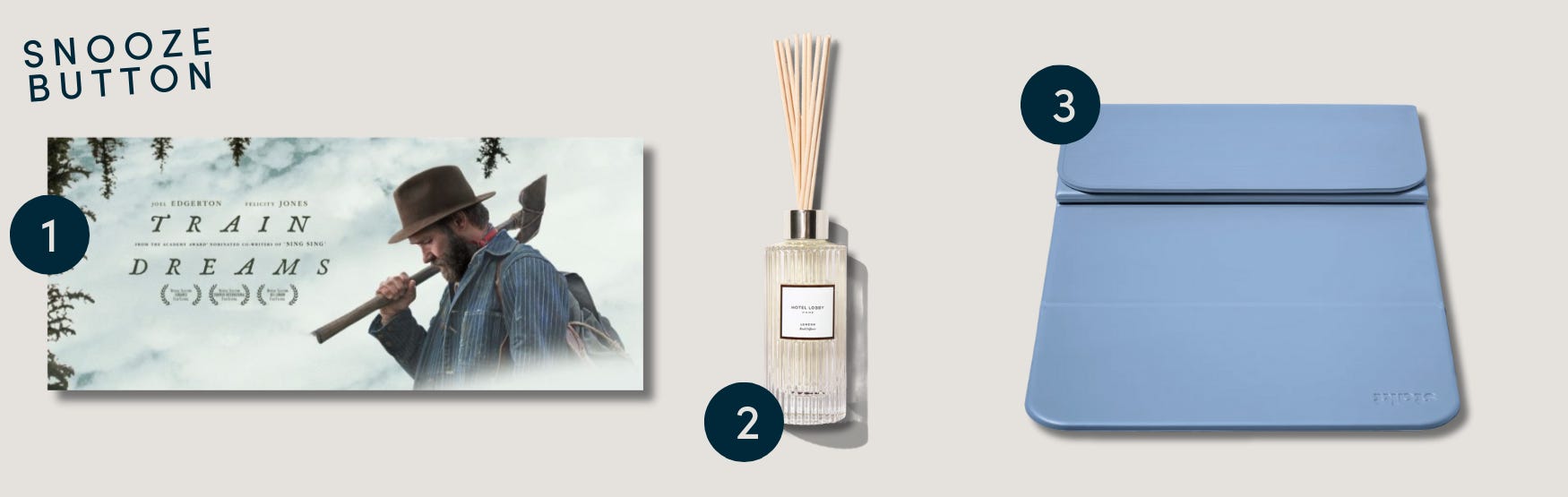
Train Dreams (Netflix) - I can’t stop thinking about this quiet, luminous film about the life of an unremarkable laborer in the 19th and 20th century Pacific Northwest. Simply put, it is stunning - visually, sonically, thematically.
One of my favorite holiday gifts this year? The Hotel Lobby London Reed Diffuser. The scent (vanilla, earl grey, honey and wisteria) is cozy and comforting without being cloying, and the diffuser reduces my anxiety about having lit candles in the house with a toddler running around.
I’m still fairly early in postpartum recovery but have been diligently working to make my rehab exercises a regular habit - something I never accomplished after my first!. The process has me reaching for my Stakt yoga mat with a new appreciation. While I’ve had mine since 2023, I primarily used it for strength training. The foldable mat, which is twice as thick as a regular yoga mat, has has been excellent during rehab — it’s foldable to provide extra support for wrists and low back, stable enough for wobbly core workouts, and cushioned enough to plop my newborn on for tummy time when she gets fussy mid-workout. 10/10.


You know exactly what you *want* to do.
Drink more water. Wake up earlier. Put your phone down during dinner, or while playing with your kids (or… ever). Actually use your gym membership. Meditate for ten minutes. Read more.
Add in the fact that it’s January, which means it’s resolution season - made more visible year after year by the proliferation of aspirational lifestyle content on the internet (... guilty). This year I’ve watched with a reserved kind of fascination from the postpartum bubble as significant quantities of the internet have declared 2026 to be their “analog year”.
Ironically, according to all the tiktok videos, instagram posts and substack articles, everyone is cutting back on screen time, deleting social media and picking up “grandma” hobbies – knitting, embroidery, film photography. The overwhelming, prevailing sense is that we all feel trapped by our devices; we’re sick of the endless scroll, we know it doesn’t make us feel good, and often get in the way of the other goals we hope to achieve. But at the end of the day, we struggle to change our behavior in any meaningful way and just keep on scrolling.
Rather than chime in on my own process for goal setting or social media and screen time (largely because I have covered both topics in depth last year ;) ) I thought it would be more interesting to do a semi-academic deep dive on the science behind behavior change;
what turns a behavior into a habit
why are “bad” habits so much harder to break than “good” habits are to implement
what it all means for changing our relationships to screens
Let’s get into it,

earlybird is an entirely reader supported publication. for weekly posts like this one, behind the scenes and access to the full archive of 150+ issues, consider upgrading to a paid subscription.
building better habits
The biggest paradox at the heart of behavior change and habit formation is this:
“Bad” habits feel automatic, but “good” habits feel impossible to build; you can scroll tiktok for an hour without thinking about it, or drive home on autopilot while your mind is completely elsewhere… but trying to eat more healthily day after day? Takes constant mental effort. Trying to get up early enough in the morning to workout more than once a week? Like pushing a boulder up a hill every single day.
Why?
Because your brain doesn’t really care about whether a habit is “good” for you – it prioritizes efficiency. And, unfortunately, many of the “bad” habits we all want to change, like checking our phones or staying up late, tend to be easier and more immediately rewarding than the “good” habits we are trying to build.
how habits are actually formed:
Bear with me for a minute: we’re going to get technical while we talk about how your brain works.
Put very simply, you can think about your brain having two different operating systems:
System 1 is The Planner: thinks ahead, makes decisions, weighs options. It’s flexible and smart, but requires a TON of mental energy and gets tired easily. This is where the majority of initial habit activity takes place – largely in a region of the brain called the prefrontal cortex (PFC) - responsible for planning and conscious control as you weigh pros and cons, manage your emotions, and inhibit impulses to revert to unwanted behavior. It feels hard because it is hard: you’re using a lot of energy and effort to think about every. single. step1
To help free up mental capacity, over time your brain shifts repetitive behaviors to system 2: Autopilot.
The Autopilot just follows patterns; if [this] then [that]. It doesn’t weigh pros or cons – it just does. It’s energy efficient and fast, but can’t adapt to new situations on its own. The autopilot system shows activity in the basal ganglia, the part of your brain largely responsible for pattern recognition and execution. When this happens, your brain is engaging the autopilot; using way less energy and conscious decision making2
When you’re well rested, not stressed, and singularly focused, the planner runs the show. You make choices aligned with your long term goals, and habit building feels doable - easy, even.. But, when you’re tired, have stress on your time or attention, or feel overwhelmed with decision making, the autopilot takes over. You default to existing patterns and old habits resurface.
Studies show that stress literally shifts control from your goal directed system to your habitual system – it’s why you might follow a routine perfectly for days and then immediately fall off the minute you have multiple things competing for your attention3. Understanding how this works means that you can build good habits that will protect you, understand when stress makes you revert to old patterns, and design systems that work even when your planner is offline.
The shift from effortful to automatic behavior is literally a physical change in your brain as it builds and wires new connections, a process called neuroplasticity. This takes actual time (not just will power)4. You haven’t failed your resolutions – you’re just in the connection building phase. And contrary to popular belief, missing a day doesn’t erase your progress:
A study from University College London tracked people as they built new habits, and the time it took for behaviors to become automatic ranged from 18 to 254 days, with an average of 66 days. Simple habits (like drinking more water) took around 21 days, while moderate habits (like going to the gym regularly took closer to 66 days… and complex habits (like establishing a meditation practice) took almost an entire year5.6
So if you’re on week two of trying to build a new habit and it still feels hard? You’re probably not finished transitioning from conscious effort to autopilot. But want to hear the most exciting (and personally liberating) finding from that study? Missing one opportunity to perform the desired habit does not materially affect the habit formation process7. Said plainly? The 75 hard, no days off, all or nothing people have it wrong. You can have a bad day. You can get sick, go on vacation, and you haven’t lost all progress – hitting your habit consistently (not perfectly) over time will still build new neural pathways.
Your brain on dopamine: why “bad” habits feel better:
So, now that we know how habits get made, why is it that your brain is more inclined to doomscroll on tiktok than it is to gear up to go to the gym.
Let’s talk dopamine – a neurotransmitter and hormone in the brain that plays a major role in memory, movement, motivation, mood, attention and (most importantly for this discussion) pleasurable reward and motivation. It turns out your brain actually releases the most dopamine when it’s anticipating a reward – not when it actually gets it8. Think about:
Refreshing your email notifications, just in case
The little pause before a text message loads
Scrolling to see just one more video in your feed
The anticipation that keeps you coming back for more (even when you just checked) a few minutes ago? That’s dopamine spiking– which is what makes digital platforms of all kinds nearly impossible to resist. They’ve engineered themselves around triggering that anticipation mechanism9.
A fascinating study from Georgetown shows that a protein called KCC2 affects how quickly your brain forms reward associations; reduced levels of this protein are associated with more rapid firing of dopamine neurons, which encourages faster formation of behavioral associations and habit formation. Early research indicates this protein may be impacted in certain mental health conditions or by use of substances, and that levels can vary person to person – possibly explaining why some people seem to form habits (and on the flip side – addictions) more easily than others10.
What this means for habit building:
For every behavior, your brain is basically running the numbers on the effort required versus the speed versus reward versus unpredictability. Unfortunately, checking your phone wins on pretty much every count:11
“Bad habits” (the ones most of us want to do less of, like scrolling on social media) tend to have immediate gratification with unpredictable, intermittent rewards that keeps you coming back for more -much like a slot machine. They also tend to have substantially easier execution with very little friction - like a phone that’s always in your pocket.
“Good” habits (the ones most of us make resolutions to try to do more of) tend to have delayed rewards: you won’t see abs after one workout, or feel major health benefits after one healthy meal, or receive the same rush of dopamine picking up a new hardcover book. They tend to have stable, predictable outcomes where you know what will happen next. Because of this, they tend to require a lot of initial effort and cognitive energy up front.
how to actually build habits that stick:
Enough about how it works and why it’s hard: Let’s talk about what actually works.
